Organizational Barriers to Communication: Causes & Solutions
Communication is the backbone of every successful organization. Whether a company is planning new strategies, coordinating projects, or maintaining team relationships, effective communication helps employees work together and achieve common goals.
However, communication within organizations is not always smooth. Many workplaces experience problems because organizational barriers to communication interfere with the flow of information. These barriers can arise from structural issues, unclear policies, technological limitations, cultural differences, or even psychological factors.
When communication barriers exist, organizations may experience misunderstandings, reduced productivity, poor decision-making, and lower employee engagement. Research frequently highlighted in workplace communication studies shows that ineffective communication is one of the major causes of workplace inefficiency and project delays.
Understanding these barriers is essential for creating a more productive and collaborative workplace.
What Are Organizational Barriers to Communication?
Organizational barriers to communication are obstacles within a company’s structure, systems, policies, or culture that prevent information from flowing effectively between employees, departments, or management levels.
These barriers often originate from:
- hierarchical organizational structures
- unclear communication channels
- departmental isolation
- technological challenges
- cultural diversity
- excessive information flow
For example, if a company has multiple management layers, information may take too long to reach decision-makers. Similarly, when departments operate independently without sharing information, teamwork becomes difficult.
Studies in organizational behavior show that companies with clear communication systems are significantly more likely to maintain high employee engagement and operational efficiency.
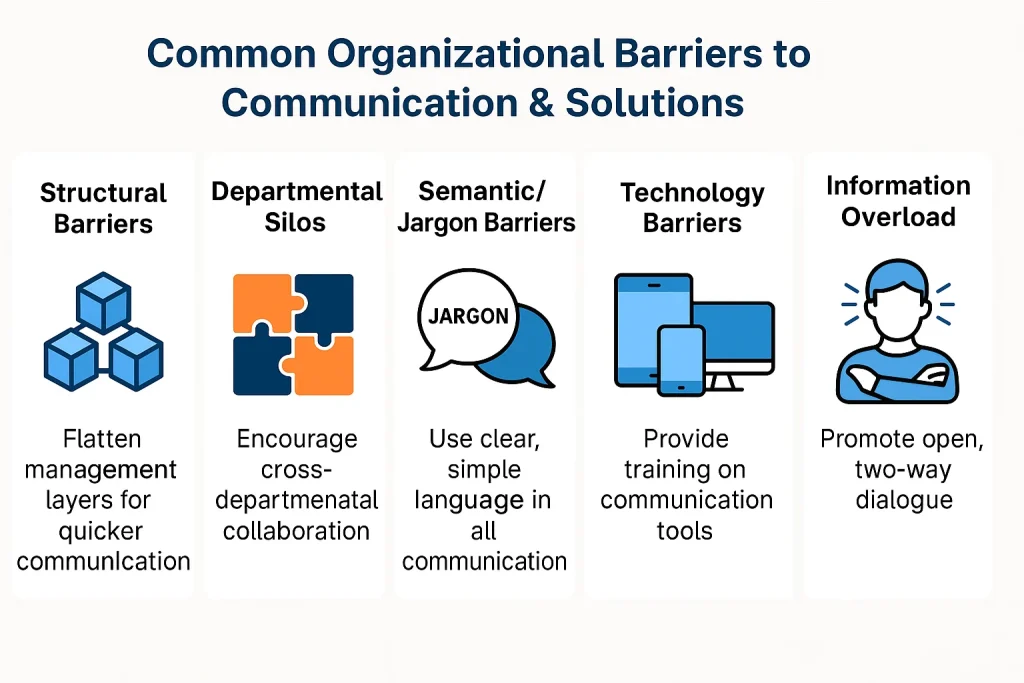
Common Organizational Barriers to Communication
Structural Barriers
Structural barriers arise from the way an organization is designed. Companies with complex hierarchies or unclear reporting structures often struggle with communication delays.
In organizations with many management levels, information must travel through multiple stages before reaching the appropriate person. During this process, messages may become distorted or delayed.
For example, an employee may report a technical issue to a supervisor, who then reports it to a department manager, who finally communicates it to senior leadership. By the time the message reaches decision-makers, the original details may have changed or lost urgency.
Organizations with flatter structures often experience faster communication because employees can interact directly with leadership and colleagues. When the obstruction is built into formal procedures and reporting systems rather than people, these become systematic barriers in communication.
Departmental Silos
Departmental silos occur when different departments operate independently with limited interaction. This can prevent employees from sharing valuable information across teams.
For example, the marketing department may collect important customer feedback, but if this information is not shared with the product development team, the company may miss opportunities to improve its products.
Silos often develop when departments focus only on their own goals rather than organizational objectives. Encouraging cross-department collaboration can reduce this barrier and improve communication.
Semantic Barriers and Jargon
Semantic barriers occur when the language used in communication is unclear or misunderstood. In many organizations, employees rely on specialized terminology or technical jargon that may not be familiar to everyone. While this language may be clear to experts within a specific department, it can confuse employees from other areas.
For instance, an IT specialist may send an email describing system updates using technical language that finance or marketing teams do not fully understand. As a result, employees may misinterpret the message or fail to follow important instructions. Problems like this are jargon barriers operating inside the workplace.
Using simple and clear language can significantly improve communication across departments.
Technological Barriers
Technology plays a major role in modern organizational communication. Email, messaging platforms, video conferencing tools, and digital collaboration software allow teams to communicate quickly and efficiently.
However, technology can also create communication challenges.
Technological barriers may arise from:
- outdated communication systems
- lack of employee training on digital tools
- unreliable internet connections
- using too many communication platforms simultaneously
When employees struggle to navigate communication tools, important information may be delayed or overlooked.
Research from the Society for Human Resource Management (SHRM) indicates that poor technology adoption and lack of training can significantly reduce workplace communication efficiency.
Information Overload
Information overload occurs when employees receive too many messages, emails, or updates within a short period.
Modern workplaces generate enormous amounts of information every day. Employees may receive dozens of emails, notifications, reports, and meeting requests throughout the day. When this happens, it becomes difficult to identify which messages require immediate attention.
Information overload can cause:
- missed deadlines
- overlooked instructions
- reduced focus
- lower productivity
Organizations can reduce this barrier by establishing clear communication guidelines and prioritizing essential information.
Psychological and Emotional Barriers
Psychological barriers relate to employees’ emotions, attitudes, and confidence levels.
Employees may hesitate to communicate openly if they:
- fear negative feedback from supervisors
- lack confidence in their ideas
- previously experienced criticism or conflict
- feel undervalued in the workplace
Emotions such as stress, anxiety, or low morale can also influence how employees interpret messages. Creating a supportive workplace culture encourages employees to share ideas and communicate more openly.
Cultural Barriers
Organizations today often employ individuals from diverse cultural backgrounds. Cultural diversity strengthens creativity and innovation, but it can also lead to misunderstandings.
Different cultures have different communication styles. Some cultures prefer direct communication, while others emphasize politeness and indirect expression.
For example, employees from cultures that value hierarchy may hesitate to question management decisions, while others may expect open discussion during meetings.
Organizations that promote cultural awareness training help employees better understand these differences and improve collaboration.
Physical Barriers
Physical barriers refer to environmental factors that interfere with communication..
Examples include:
- office layouts that separate teams
- remote work environments
- lack of meeting spaces
- geographical distance between offices
Remote work, which has become increasingly common, requires structured communication systems such as video meetings, project management tools, and digital collaboration platforms.
Without proper communication systems, remote employees may feel disconnected from the rest of the team.
Gossip and Informal Communication
Informal communication networks, often referred to as the “grapevine,” can spread information quickly within organizations. While informal communication can strengthen relationships, it can also lead to misinformation.
Rumors or incomplete information can distort messages and create confusion among employees. When employees rely on gossip rather than official communication channels, trust within the organization may decline.
Leaders should maintain transparent communication to prevent misinformation from spreading.
Lack of Feedback and Active Listening
Effective communication requires two-way interaction. When feedback mechanisms are missing, communication becomes one-sided.
- Employees may receive instructions but lack opportunities to ask questions or clarify misunderstandings.
- Encouraging feedback and active listening improves communication accuracy and helps identify problems early.
- Performance reviews, team discussions, and employee surveys can help organizations gather valuable feedback.
Organizational Barriers Examples
- Understanding real workplace situations can help illustrate how these barriers affect organizations.
- Example 1: A company with multiple management layers delays project approvals, causing missed deadlines and reduced productivity.
- Example 2: Departments fail to share customer feedback, resulting in duplicated work and missed business opportunities.
- Example 3: Remote teams use different communication platforms, making it difficult to coordinate projects.
- Example 4: Employees overlook important emails because they receive too many daily messages.
- Example 5: Cultural misunderstandings cause tension between international team members.
- These examples show how communication barriers can affect both daily operations and long-term organizational success.
Effect of Communication Barriers on the Workplace

Communication barriers can significantly impact organizational performance.
Some common consequences include:
- Reduced productivity because employees misunderstand instructions.
- Lower employee morale when workers feel ignored or disconnected.
- Poor decision-making due to incomplete or inaccurate information.
- Increased employee turnover when staff feel frustrated with communication problems.
- Reduced innovation because employees hesitate to share ideas.
Research from Gallup suggests that employees who feel their opinions are valued are significantly more engaged in their work. Organizations that address communication barriers often experience higher productivity and stronger teamwork.
How to Overcome Organizational Barriers to Communication
Improving organizational communication requires both structural improvements and cultural changes. Below are practical strategies that organizations can implement.
Foster Open Communication
Organizations should encourage employees at all levels to share ideas and feedback. Regular team meetings, employee suggestion systems, and open-door leadership policies can help create a culture of transparency.
Clarify Communication Policies
Clear communication policies help employees understand how and when to share information. Organizations should define preferred communication channels for different types of messages, such as emails, meetings, or collaboration platforms.
Simplify Language
Using clear and simple language reduces confusion. Employees should avoid unnecessary technical jargon in general communication and explain specialized terms when necessary.
Improve Technology Training
Organizations should ensure employees are properly trained to use communication tools. Providing training sessions and technical support helps employees communicate more effectively using digital platforms.
Reduce Information Overload
Managers should prioritize important messages and avoid sending excessive updates. Centralized communication platforms can help employees easily locate relevant information.
Encourage Cross-Department Collaboration
Breaking down departmental silos encourages teamwork. Cross-functional projects, collaborative meetings, and shared communication platforms can help departments exchange information more effectively.
Support Employee Well-Being
Organizations should recognize the role of emotional and psychological factors in communication. Providing supportive leadership and promoting employee well-being encourages open dialogue.
Monitor Communication Effectiveness
Organizations should regularly evaluate their communication systems through employee surveys, performance reviews, and communication audits. These evaluations help identify communication challenges and opportunities for improvement.
Conclusion
Organizational barriers to communication can arise from structural design, cultural differences, technological limitations, or psychological factors. When these barriers exist, they interfere with the flow of information, reduce employee engagement, and hinder organizational performance.
By understanding the causes of communication barriers and implementing practical strategies—such as improving communication policies, encouraging collaboration, simplifying language, and supporting employees—organizations can create more effective communication systems.
Strong communication is not only essential for daily operations but also plays a critical role in building a positive organizational culture and achieving long-term success.