10 Barriers to Oral Communication (and How to Overcome Them)
Barriers to oral communication are the hidden reasons even simple conversations break down—the noisy room that swallows your message, the cultural gap that makes an exchange awkward, the stress that stops you from really listening. You share an important idea and watch the other person look confused or uninterested, and you’re left wondering why it didn’t land.
Communication is more than talking and listening. It’s about connecting minds so both sides genuinely understand each other. Whether you’re at work, in school, or chatting with friends, recognizing the most common types of communication barriers is essential for building stronger relationships and getting things done. This guide breaks down ten of them and gives you a practical fix for each.
What is Oral Communication?
Oral communication is the process of exchanging ideas, feelings, and information through spoken words. It covers everything from one-on-one conversations to presentations, team meetings, customer service calls, and classroom discussions. Success depends on the speaker and the listener working together, supported by clear language, tone of voice, and nonverbal cues like facial expressions and gestures. Because it’s the spoken side of communication, oral exchanges share many of the same pitfalls as broader verbal communication barriers, which also cover written messages.
Good oral communication is about more than saying words. It’s about making sure the other person actually receives the message you intend. For that to happen, both people have to pay attention, respond, and sometimes adjust their approach when things aren’t going smoothly.
Why Barriers to Oral Communication Matter
When barriers get in the way, people stop truly connecting—and that leads to mistakes, missed opportunities, and frustration. In business, poor communication causes project delays and financial losses. In healthcare, a misunderstanding can cause errors or patient dissatisfaction. Even at home, these barriers can strain relationships and chip away at confidence.
Understanding the challenge is the first step to fixing it. From physical noise to emotional tension, every barrier has its own impact—and every one of them can be reduced with the right strategy.
The 10 Main Types of Communication Barriers
To communicate well, it helps to know what can get in the way. Here are the most common barriers to oral communication you might face in daily life.
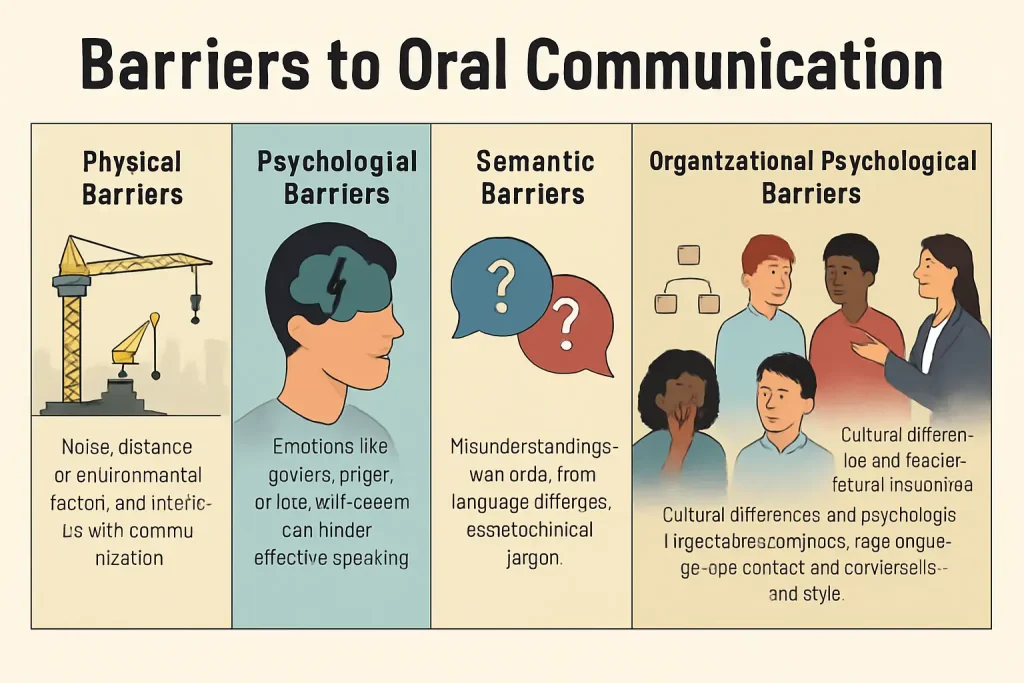
1. Physical Barriers
Physical barriers are obstacles in the environment that make it hard to speak or hear clearly—a crowded restaurant, a construction site, or a dropped phone connection. Among the most common are physical barriers like noise, distance, and poor acoustics.
Examples
- Noise from traffic, machines, or nearby conversations
- Physical distance between speakers
- Poor acoustics in a large room
- Technical problems with microphones or speakers during video calls
How to overcome it
- Choose quiet places for important conversations
- Use tools like noise-canceling headphones or better microphones
- Make sure the environment supports clear sound before you begin
The National Communication Association emphasizes minimizing environmental distractions so messages can be heard as intended.
2. Psychological Barriers
Our own minds get in the way too. Psychological barriers include stress, anxiety, fear, distraction, low self-esteem, and prejudice. They make us misread messages or hold back from speaking honestly.
Examples
- Worrying about being judged, so someone keeps an idea to themselves
- Anger or frustration that blocks open-minded listening
- Preconceived notions that replace genuine listening with assumptions
How to overcome it
- Practice staying present and focused in the conversation
- Address strong emotions before tackling a difficult topic
- Build trust so people feel safe expressing themselves
Research from the American Psychological Association links emotional self-awareness to clearer, less reactive communication.
3. Semantic and Language Barriers
Sometimes the words themselves are the problem. Semantic barriers arise when people use vocabulary, jargon, slang, or technical terms that others don’t share. Even within one language, meaning shifts by region, background, or profession. When the gap comes from people not sharing a language or the same fluency level, these become language-related barriers.
Examples
- Medical staff using clinical terms with patients who don’t know them
- Slang that confuses someone from a different region
- Accents and dialects that make certain words hard to catch
How to overcome it
- Use clear, simple language wherever possible
- Define terms and skip jargon unless everyone understands it
- Invite questions and clarify confusing words
4. Organizational Barriers
In workplaces and institutions, structure and culture can stop information from flowing. These workplace communication barriers include rigid hierarchies, unclear reporting lines, weak feedback systems, and power dynamics that discourage people from speaking up.
Examples
- Employees afraid to share ideas with managers
- Weak feedback channels that create one-way communication
- Remote teams that struggle to connect without personal interaction
How to overcome it
- Encourage open, two-way communication
- Flatten hierarchies where possible so everyone feels heard
- Use regular check-ins, virtual meetings, or town halls
The Society for Human Resource Management (SHRM) stresses building cultures that support communication across every level of an organization.
5. Nonverbal Barriers
Much of what we “say” never comes from our mouths. Nonverbal communication includes facial expressions, gestures, posture, eye contact, and even silence. When these signals contradict the words, confusion follows.
Examples
- Saying “I’m fine” with a frown or crossed arms
- Avoiding eye contact in a way that signals discomfort
- Standing too close or too far, making the other person uneasy
How to overcome it
- Match your nonverbal cues to your words
- Stay aware of cultural differences in gestures and personal space
- Watch the listener’s body language for signs of confusion
6. Cultural and Linguistic Diversity
In multicultural teams and global workplaces, barriers multiply. Differences in customs, values, language, and expectations can create misunderstandings or unintentional offense.
Examples
- A hand gesture that means something entirely different elsewhere
- Different norms around formality and directness
- Idioms and sayings that don’t translate
How to overcome it
- Learn about the cultural backgrounds of your audience or team
- Avoid idioms and culture-specific jokes in diverse groups
- Invite everyone to share their communication preferences
7. Channel and Technical Barriers
The “channel” is the method carrying your message—face-to-face, phone, video, or audio. Problems in the channel, like poor audio or slow internet, become real barriers. These mechanical and technical disruptions can corrupt a message before it ever reaches the listener.
Examples
- Static or lag during a virtual meeting
- Unclear or dropped calls
- Low-quality microphones distorting voices
How to overcome it
- Invest in reliable technology for important conversations
- Test equipment before meetings
- Use video when you can, since seeing faces aids understanding
8. Perceptual Barriers
Perceptual barriers occur when people interpret messages through personal filters—past experiences, beliefs, and biases—causing misinterpretation even when the message is clear.
Examples
- A manager’s feedback heard as criticism because of past experiences
- Cultural background shaping how humor or a compliment is received
- Personal bias against a topic causing someone to tune out
How to overcome it
- Ask for feedback: “How did you understand that?”
- Stay aware of your own filters and biases
- Clarify your intent when you sense confusion or defensiveness
9. Lack of Active Listening
Active listening means fully focusing on the speaker, understanding the message, and responding thoughtfully. Failing to do it is one of the biggest barriers to effective communication.
Signs of poor listening
- Interrupting before the other person finishes
- Planning your reply while they’re still talking
- Missing key points or needing things repeated
How to overcome it
- Maintain eye contact and show genuine interest
- Paraphrase what you heard before responding
- Ask open-ended questions to confirm understanding
10. Feedback Loop Breakdown
Communication works best when there’s a feedback loop—the receiver responds to show whether the message landed. When feedback is missing or unclear, misunderstandings linger.
How to overcome it
- Invite questions and comments after sharing information
- Summarize what you heard to confirm agreement
- Build in chances for feedback through meetings, surveys, and follow-ups
| Barrier | Common Example | Quick Fix |
|---|---|---|
| Physical | Background noise, bad phone line | Pick a quiet space; upgrade audio gear |
| Psychological | Stress, fear of judgment | Address emotions first; build trust |
| Semantic / Language | Jargon, slang, accents | Use plain language; define terms |
| Organizational | Rigid hierarchy, weak feedback | Encourage two-way, open communication |
| Nonverbal | Words and body language clash | Align cues; read the listener |
| Cultural | Gestures or idioms misread | Learn the audience; skip idioms |
| Channel / Technical | Lag, dropped calls | Test tech; prefer video |
| Perceptual | Feedback heard as attack | Ask how it was understood |
| Poor Listening | Interrupting, distraction | Paraphrase; ask open questions |
| Feedback Breakdown | No response to confirm | Summarize; invite questions |

Models That Explain Communication Barriers
Communication experts use models to map how messages travel. The Shannon-Weaver Model—Sender, Message, Channel, Receiver, Feedback, and Noise—is widely used in academic and business settings, and each stage is a place a barrier can appear:
- The sender may use unclear language.
- The channel (phone, video) may fail for technical reasons.
- The receiver may misinterpret through cultural or personal filters.
- Noise, literal or figurative, may distort the message.
- Feedback closes the loop and reveals whether the message was understood.
Knowing the model helps you pinpoint exactly where a conversation is breaking down—and fix it faster.
The Real Impact of Poor Oral Communication
Barriers don’t just cause small hiccups; they create real consequences:
- Misunderstandings and errors — instructions go unfollowed and work has to be redone.
- Reduced productivity — time and energy drain away clearing up confusion.
- Low morale and trust — teams feel disconnected or ignored.
- Lost business — in sales and negotiation, poor communication costs deals.
- Safety risks — in healthcare, aviation, and emergency services, unclear communication can be a matter of life and death.
The scale is significant. According to the Project Management Institute’s 2013 Pulse of the Profession report, ineffective communication is the primary contributor to project failure roughly one-third of the time, and it puts about 56% of project budgets at risk. That’s a strong case for tackling these barriers head-on.
How to Overcome Barriers to Oral Communication
Every barrier can be reduced with the right approach. These strategies work across nearly all of them:
- Listen actively — show you care about the speaker’s words and feelings.
- Keep language simple — choose words everyone understands.
- Ask for feedback — check whether your message made sense.
- Adapt your style — adjust tone and formality to the listener and situation.
- Confirm understanding — paraphrase key points so everyone’s aligned.
- Use technology wisely — pick reliable channels everyone can use.
- Build cultural awareness — respect differences and learn about your audience.
- Train regularly — keep skills sharp with workshops or online courses.
Frequently Asked Questions
What are the main barriers to oral communication?
The most common barriers are physical, psychological, semantic or language, organizational, nonverbal, cultural, channel or technical, perceptual, lack of active listening, and feedback breakdown. Each can distort a message at a different point between speaker and listener.
What is the difference between physical and psychological barriers?
Physical barriers come from the environment—noise, distance, or bad audio—while psychological barriers come from within, such as stress, fear, bias, or distraction. Physical barriers block the signal; psychological barriers block the mind’s openness to it.
How can you overcome barriers to oral communication?
Use simple language, listen actively, confirm understanding by paraphrasing, choose a quiet and reliable channel, stay aware of cultural and personal filters, and invite feedback so you can confirm the message was received as intended.
Why is active listening important in oral communication?
Active listening ensures the receiver actually understands the speaker rather than just hearing words. It reduces misinterpretation, signals respect, and closes the feedback loop that makes communication two-way instead of one-directional.
What are common barriers to communication in the workplace?
Workplace barriers include background noise, language and accent differences, poor listening, vague or jargon-heavy messages, emotional interference, status differences that discourage speaking up, assumptions and bias, and information overload.
Which communication model explains these barriers?
The Shannon-Weaver Model is the most widely used. It frames communication as Sender, Message, Channel, Receiver, Feedback, and Noise—and each stage shows where a barrier can interrupt the message.
Conclusion
Barriers to oral communication affect everyone at some point. But with awareness, patience, and a few practical tools, they don’t have to last. Strong oral communication builds trust, boosts productivity, and brings people closer together—at work, at home, and in the community.
If you’re ready to communicate more clearly, start small: listen actively, check your environment, ask for feedback, and stay open to learning. Each adjustment chips away at the barriers standing between your message and the person who needs to hear it.


