Physical Barriers to Listening: Causes, Examples, and How to Overcome Them
Have you ever struggled to hear someone because of loud traffic, echoing rooms, or constant phone notifications? Situations like these are common examples of physical barriers to listening.
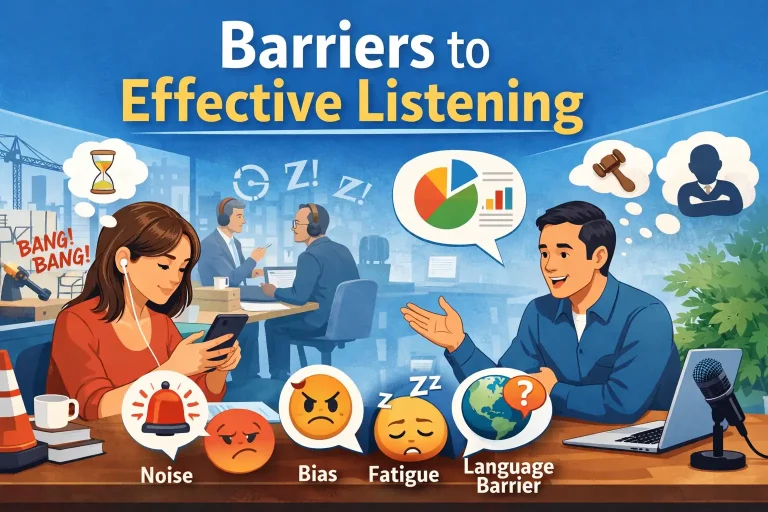
Physical barriers to listening are environmental factors that interfere with our ability to hear and understand spoken messages clearly. These barriers include background noise, poor acoustics, distracting technology, and physical distance between speakers and listeners.
Communication researchers emphasize that effective listening depends not only on attention but also on the environment. According to communication scholar Judi Brownell, listening accuracy declines when environmental distractions increase because the brain must divide attention between multiple stimuli.
Understanding these physical barriers can help individuals create better communication environments at work, school, and home.
Contents
What Are Physical Barriers to Listening?
Physical barriers are external environmental conditions that disrupt listening. Unlike psychological barriers—such as stress or emotional reactions—physical barriers originate from the listener’s surroundings.
These barriers affect how sound travels, how clearly speech is heard, and how easily a listener can focus on a conversation.
Common examples include:
- background noise from traffic or machinery
- poor room acoustics causing echo or distortion
- visual distractions such as movement or flashing screens
- interruptions from smartphones and digital devices
- large distances between speaker and listener
When these obstacles are present, listeners must work harder to understand the message, which often leads to misunderstanding or missed information.
For a broader understanding of communication obstacles, you may also explore our guide on barriers of communication, which explains how physical, psychological, and cultural barriers affect conversations.
Common Physical Barriers to Listening
| Barrier | How It Affects Listening |
|---|
| Traffic or construction noise | Makes speech difficult to distinguish |
| Echo or reverberation | Words blend together and lose clarity |
| Device notifications | Interrupt concentration and thought flow |
| Poor room layout | Sound does not travel clearly |
| Distance from speaker | Reduces both sound volume and visual cues |
How Physical Distractions Affect Listening
The human brain has a limited capacity for processing information. When multiple sensory inputs compete for attention—such as noise, visual movement, or digital alerts—it becomes harder to focus on the speaker.
Research in communication psychology shows that distractions increase cognitive load, making it more difficult for listeners to process and retain spoken information.
For example:
- In a noisy café, listeners must separate the speaker’s voice from background conversations.
- In an echoing lecture hall, speech reflections make words harder to understand.
- During video calls, notifications and screen distractions divide attention.
Even small distractions, when repeated frequently, can significantly reduce listening effectiveness.
Where Physical Listening Barriers Are Most Common
Physical listening barriers appear in many everyday environments.
Office Settings
Modern open-plan offices encourage collaboration but also create constant noise. Conversations, ringing phones, printers, and office equipment compete for attention.
When employees sit far apart or are separated by partitions, it becomes harder to hear clearly and interpret body language.
Noise distractions can also combine with psychological barriers to communication such as stress or mental fatigue, making listening even more difficult.
Educational Institutions
Classrooms and lecture halls often struggle with acoustics. Students seated at the back may find it difficult to hear instructors clearly, especially if there is hallway noise or technical problems with microphones.
In such environments, students may miss important explanations or instructions.
Healthcare Environments
Hospitals and clinics are surprisingly noisy places. Medical equipment alarms, announcements, and hallway activity create a complex sound environment.
Patients who are anxious or dealing with hearing challenges may struggle to understand doctors’ instructions, which can affect healthcare communication.
Communication problems in these settings are also linked to barriers to communication in healthcare.
Public Spaces
Restaurants, shopping malls, train stations, and airports are filled with competing sounds. Announcements, conversations, music, and crowd noise create a situation where listening requires extra effort.
Homes and Remote Workspaces
Even home environments can create listening barriers. Household noise, barking dogs, television sounds, or poor internet connections can disrupt virtual conversations.
Rooms with hard floors and empty walls often produce echo, making voices sound distorted during video meetings.
Physical Barriers in Digital Communication
Online communication introduces its own physical listening challenges.
Common issues include:
- Low-quality microphones
- Echo from empty rooms
- Background noise during calls
- Poor internet connections
- Delayed audio transmission
These issues can cause people to speak over one another or misunderstand important information.
Using headphones with built-in microphones, enabling noise suppression, and testing audio settings before meetings can improve digital listening.
Practical Ways to Reduce Physical Barriers
Fortunately, many environmental barriers can be reduced with small adjustments.
Choose Quieter Locations
When possible, hold important conversations in quiet rooms rather than noisy public areas. Closing doors or moving away from busy corridors can significantly improve listening quality.
Improve Room Acoustics
Soft materials absorb sound and reduce echo. Consider adding:
- Rugs or carpet tiles
- Thick curtains
- Fabric wall panels
- Upholstered furniture
Even bookshelves placed along walls can help absorb sound reflections.
Minimize Visual Distractions
Too much visual activity can divert attention away from the speaker.
Reduce distractions by:
- turning off unnecessary screens
- closing extra browser tabs
- avoiding cluttered environments
Limit Device Interruptions
Smartphones and notifications frequently interrupt conversations.
During meetings or discussions:
- silence phone notifications
- disable non-essential alerts
- avoid multitasking
Research consistently shows that multitasking lowers comprehension and information retention.
Adjust Physical Layout
Communication improves when speakers and listeners can both hear and see each other clearly. Arrange seating so everyone is within comfortable speaking distance and has a clear line of sight.
Support Speech with Visual Aids
Visual materials such as slides, charts, or written summaries can reinforce spoken messages. This is especially helpful in classrooms, presentations, or multilingual settings.
A Real-World Example of Physical Listening Barriers
Imagine a team meeting in an open office. One employee is explaining a new project plan while several coworkers are talking nearby, a printer is running, and phones are ringing.
At the same time, some participants are checking notifications on their laptops.
In this situation, multiple physical barriers combine:
- environmental noise
- visual distractions
- device interruptions
As a result, several team members misunderstand the instructions, leading to confusion later in the project.
By moving the meeting to a quiet room and reducing device distractions, the team could significantly improve communication.
Final Thoughts
Listening is often viewed as a personal skill, but the environment plays a major role in how well people understand one another. Physical barriers—such as noise, poor acoustics, digital interruptions, and room layout—can quietly undermine communication in everyday situations.
The good news is that many of these barriers are easy to reduce. Small changes like choosing quieter spaces, adjusting seating arrangements, or limiting device distractions can dramatically improve listening quality.
If communication feels difficult, take a moment to examine your surroundings. Sometimes the problem is not the message itself—but the environment in which it is delivered.