What are the 5 Barriers for Persons with Disabilities?
Barriers faced by persons with disabilities continue to limit access to education, employment, healthcare, transportation, and social participation across the world. These barriers are not always visible. They can appear as physical obstacles, inaccessible technology, communication difficulties, negative social attitudes, or financial limitations. For millions of people, these challenges create daily frustrations and missed opportunities.
Understanding the barriers faced by persons with disabilities is essential for building a more inclusive society. When communities recognize these obstacles and work to remove them, people with disabilities gain greater independence, participation, and quality of life.
According to the World Health Organization, more than one billion people worldwide—about 15% of the global population—live with some form of disability. This statistic highlights why accessibility and inclusion must be priorities in public policy, education, workplaces, and digital environments.
Contents
Understanding Disabilities
Disability is not a single condition. It includes a wide range of physical, sensory, intellectual, developmental, and mental health conditions that may affect a person’s ability to perform everyday activities.
Some disabilities are visible. For example:
- individuals who use wheelchairs
- people who rely on white canes for visual impairments
- people using hearing aids
Other disabilities may not be immediately noticeable, such as:
- chronic illnesses
- learning disabilities like dyslexia
- mental health conditions such as depression or anxiety
Experts often explain disability through the social model of disability. This model suggests that disability is not caused only by a person’s physical or mental condition. Instead, disability often results from environmental and social barriers that prevent people from fully participating in society.
For instance, a wheelchair user is not limited by mobility alone. A building without ramps or elevators creates the real barrier. Removing that barrier allows the individual to access the space independently.
Understanding disability in this broader context helps societies focus on improving accessibility rather than simply focusing on limitations.m
Five Major Barriers Faced by Persons with Disabilities
People with disabilities encounter several types of barriers that can limit opportunities and independence. The most common categories include physical, digital, attitudinal, communication, and economic barriers.

Physical Barriers
Physical barriers are often the most visible obstacles faced by people with disabilities. These barriers occur when buildings, public spaces, or transportation systems are not designed with accessibility in mind.
Examples include:
- stairs without wheelchair ramps
- narrow doorways that prevent wheelchair access
- sidewalks without curb ramps
- buildings lacking elevators
- inaccessible public transportation
Other physical barriers are less obvious but equally important. For example:
- medical equipment that requires patients to stand
- desks or service counters that are too high for wheelchair users
- absence of tactile paving or braille signage for people with visual impairments
Physical accessibility is essential for participation in daily life. Without accessible infrastructure, individuals may struggle to attend school, work, or public events.
Digital Barriers
In the modern world, access to digital technology is critical for education, employment, and communication. However, digital environments are not always designed with accessibility in mind.
Digital barriers arise when websites, applications, or online services cannot be used by people with disabilities.
Common digital barriers include:
- websites incompatible with screen readers
- videos without captions for deaf or hard-of-hearing users
- forms that cannot be completed using keyboard navigation
- poor color contrast that makes text difficult to read
Research by WebAIM found that over 96% of the top one million websites contain accessibility errors, such as missing alternative text for images or inaccessible navigation structures.
To improve digital accessibility, organizations follow the Web Content Accessibility Guidelines (WCAG), which provide international standards for making digital content usable for individuals with diverse abilities.
Attitudinal Barriers
Attitudinal barriers arise from stereotypes, prejudice, and misconceptions about people with disabilities. These barriers can be more difficult to identify than physical obstacles but can have equally serious consequences.
Examples include:
- employers assuming people with disabilities cannot perform certain jobs
- teachers underestimating the abilities of students with disabilities
- social stigma that isolates individuals from community activities
Even well-intentioned attitudes, such as pity or overprotection, can limit opportunities. When society focuses on limitations instead of abilities, individuals may be denied equal participation.
Changing public attitudes requires education, awareness campaigns, and positive representation of people with disabilities in media and leadership roles.
Communication Barriers
Communication barriers occur when information is not accessible to everyone. People with disabilities may require different communication formats, such as:
- sign language interpretation
- braille materials
- plain-language documents
- captioned videos
- audio descriptions
Without these accommodations, individuals may struggle to access important information in healthcare, education, or public services.
For example, a deaf patient in a hospital may not fully understand medical instructions if a sign language interpreter is unavailable. Similarly, complex written materials may be difficult for individuals with cognitive or learning disabilities.
Accessible communication ensures that everyone can receive and share information effectively.
Economic Barriers
Economic challenges can significantly affect the lives of people with disabilities. Studies from the International Labour Organization show that people with disabilities are often twice as likely to be unemployed or underemployed compared to those without disabilities.
Several factors contribute to these economic barriers:
- limited job opportunities
- workplaces that lack accessibility accommodations
- discrimination during hiring processes
- higher costs for healthcare and assistive devices
Additional expenses, such as accessible transportation or specialized equipment, can place financial strain on individuals and families.
Reducing economic barriers requires inclusive employment policies, workplace accessibility improvements, and stronger legal protections.
Intersectionality and Disability
Disability does not exist in isolation. People may experience multiple forms of discrimination based on factors such as gender, race, socioeconomic status, or geographic location. This concept is known as intersectionality.
For example:
- women with disabilities may face both gender discrimination and disability discrimination
- people living in rural areas may have limited access to healthcare or assistive services
- individuals from low-income communities may struggle to afford assistive devices
Recognizing these overlapping challenges helps policymakers and organizations develop more effective and inclusive support systems.
Laws, Rights, and Accessibility Standards
Many countries have established laws and international agreements to protect the rights of people with disabilities.
Important frameworks include:
United Nations Convention on the Rights of Persons with Disabilities (UNCRPD)
This international treaty promotes equality, accessibility, and full participation for people with disabilities worldwide.
Americans with Disabilities Act (ADA)
This U.S. law prohibits discrimination and requires accessible environments in employment, transportation, and public services.
Web Content Accessibility Guidelines (WCAG)
These global standards guide organizations in creating accessible digital platforms.
Although these frameworks are essential, enforcement and implementation remain ongoing challenges in many regions.
Assistive Technologies
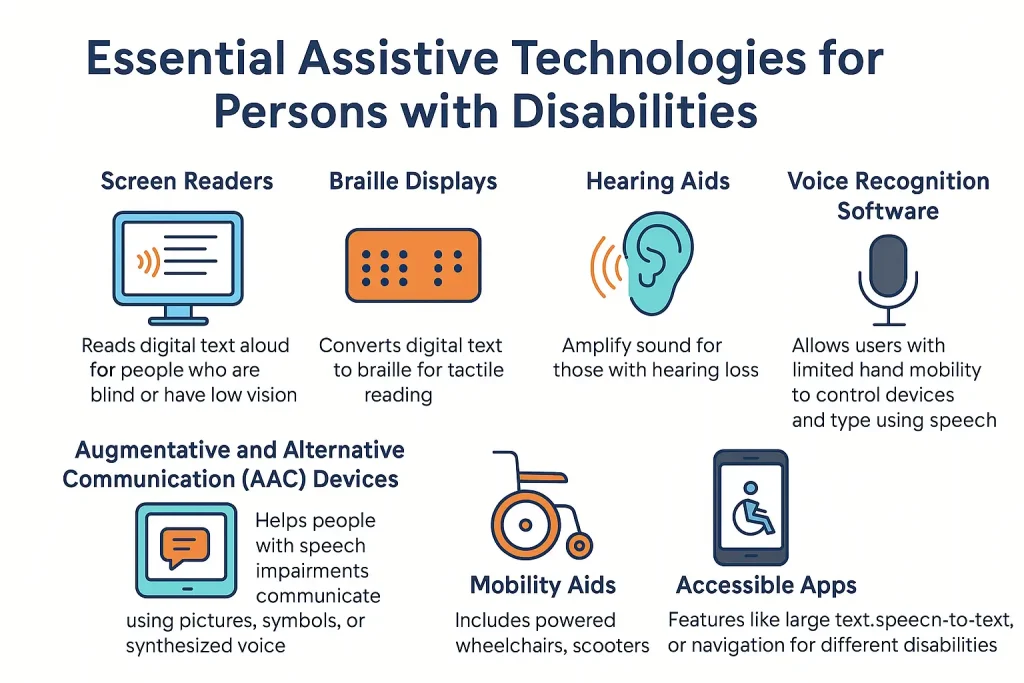
Assistive technology plays a vital role in reducing barriers and improving independence for people with disabilities.
Examples include:
- screen readers that convert text into speech for individuals with visual impairments
- voice recognition software that allows users to control devices using speech
- braille displays that translate digital text into tactile characters
- augmentative and alternative communication (AAC) devices for individuals with speech impairments
- accessible mobile applications that support navigation, communication, and daily tasks
Emerging technologies such as artificial intelligence, smart home systems, and wearable devices continue to expand accessibility opportunities.
The Role of Families and Caregivers
Families and caregivers often provide essential support for individuals with disabilities. They may assist with daily activities, advocate for services, and help navigate healthcare or education systems.
However, caregiving can also create emotional and financial pressures. Access to resources such as counseling, respite care, and community support networks can help families maintain well-being.
Peer support groups and self-advocacy organizations also provide valuable connections, information, and empowerment for both individuals with disabilities and their families.
Practical Solutions for Inclusion
Creating inclusive communities requires collective effort from governments, organizations, and individuals.
Some practical actions include:
- Ensure buildings include ramps, elevators, tactile signage, and accessible restrooms.
- Follow WCAG standards to make websites and digital tools usable for everyone
- Provide captions, sign language interpretation, and plain-language materials.
- Education and training programs help reduce stigma and encourage inclusive behavior.
- Policies and programs should be designed with input from individuals who experience these barriers firsthand.
Conclusion
Barriers faced by persons with disabilities affect many aspects of life, including education, employment, healthcare, and social participation. These barriers can be physical, digital, social, communication-related, or economic.
By recognizing and addressing these obstacles, societies can create environments where people with disabilities have equal opportunities to participate and thrive.
Accessibility is not simply a legal requirement—it is a commitment to fairness, dignity, and human rights. When communities remove barriers and embrace inclusion, everyone benefits.